
What are the most popular backyard water features right now?
The most popular backyard water features right now are sheer descent spillways, scuppers, deck jets, bubblers, and natural-style rock waterfalls. Each one suits a different space and sound level. The right choice depends on how much room you have, how much noise you want, and whether the feature can be planned with correctly sized plumbing and an efficient pump from the start.
Moving water changes how a backyard feels. It adds sound that softens street noise, light that dances across surfaces, and a focal point that looks good from the kitchen window as well as from the pool deck. That is why water features keep showing up on homeowner wish lists across Los Angeles and the San Fernando Valley.
The trend is moving away from oversized rock piles and toward cleaner, more architectural features that match modern homes. At the same time, homeowners are asking sharper questions about pump size, splash, noise, and water use, which is the right instinct. A feature that looks great in a rendering but runs loud or wastes water becomes a daily annoyance.
What Counts as a Backyard Water Feature
A water feature is any element that moves or displays water for sound, motion, or visual interest. In a pool setting that includes waterfalls, spillways, scuppers, deck jets, bubblers, raised walls with sheeting water, and spa spillovers. Standalone fountains and pondless basins fit the same category for yards without a pool.
Most features fall into two groups. Pool-integrated features share the pool’s water and usually need their own dedicated pump and plumbing so they do not starve the main circulation. Standalone features use a small reservoir and recirculating pump, which makes them easier to add but limits their scale.
Sheer Descents and Spillways
A sheer descent is a thin, smooth sheet of water that falls from a narrow slot into the pool or a basin below. It is the signature feature of modern design because it produces a crisp, glass-like line and a soft, steady sound.
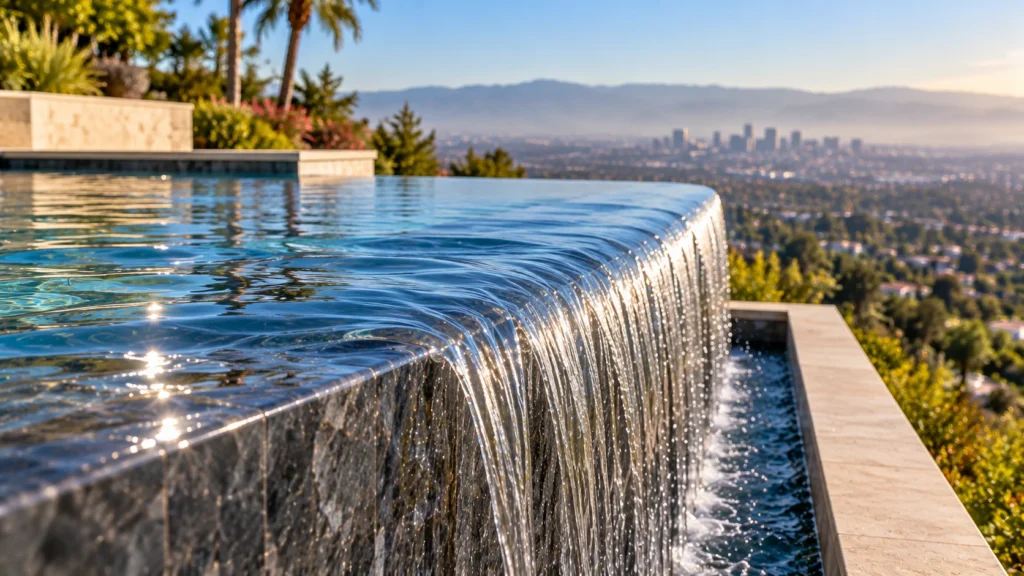
Spillways work on the same idea at a larger scale. Water flows over a raised wall or the edge of a raised spa and drops into the pool. They look best when the wall material, tile, and coping are chosen together, so the lip of the spillway stays level and the water sheets evenly instead of breaking into streams.
Level matters more than most people expect. A spillway that is off by a small amount will pour from one corner, so installation precision is a real quality marker.
Rock Waterfalls and Natural-Style Features
Natural-style waterfalls use stone, boulders, and planting to look like part of the landscape. They suit freeform pools and larger lots, and they create more splash and a louder sound than a sheer descent.
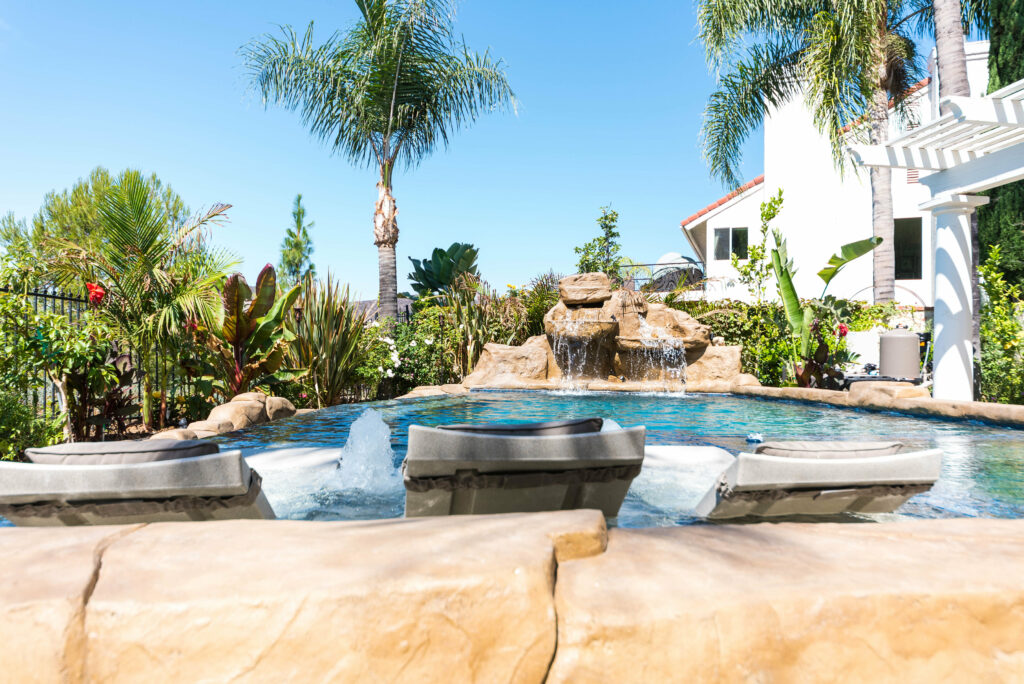
The trend here is restraint. Instead of tall rock mountains, designers are using lower ledges and a few well-placed stones that blend with the deck. Hillside lots can use the grade itself, with the feature stepping down toward the water.
Scuppers, Deck Jets, and Bubblers
These smaller features add motion without a lot of structure.
- Scuppers are spouts mounted on a wall that pour water into the pool in a visible stream. They add sound and a sculptural detail to a raised wall.
- Deck jets shoot thin arcs of water from the deck into the pool. They are playful and popular with families.
- Bubblers release a gentle upwelling of water, often on a shallow shelf, and work well in a compact space.
| Feature | Sound level | Space needed | Typical fit |
|---|---|---|---|
| Sheer descent | Soft and steady | Needs a raised wall or ledge | Modern and architectural designs |
| Rock waterfall | Louder, more splash | Moderate to large | Freeform and natural designs |
| Scuppers | Moderate | Needs a wall | Raised walls and spa fronts |
| Deck jets | Light | Minimal | Family-focused pools |
| Bubblers | Very light | Minimal, often a shallow shelf | Small yards and tanning ledges |
Treat the table as a starting point. Actual sound and splash depend on the water volume, the drop height, and what the water lands on.
Plan the Plumbing, Pump, and Lighting First
The best water features are designed before the shell is built. GWP Builders Inc. describes its water features and waterfalls as using dedicated, correctly sized plumbing and pumps so features run quietly, with lighting integrated and controls tied into automation. Features can often be added to an existing pool as well, though that takes a closer look at the equipment and plumbing already in place.
Three planning points deserve attention before you pick a style:
- Flow and pump size. A feature that is under-supplied looks weak, and one that is over-supplied is loud and splashy.
- Noise. Water falling a short distance into deep water sounds calmer than water hitting stone or shallow water. Think about where bedrooms and neighbors are.
- Lighting. Lit water at night looks dramatic, and it is much easier to wire during construction than later.
Efficiency and Water Use in Southern California
Pumps are the energy cost of any water feature. According to the California Energy Commission, replacement dedicated-purpose pool pump motors of 0.5 horsepower or more must be variable-speed models in California, which is one reason efficient equipment is now part of most feature designs. Variable-speed operation also lets a feature run at a lower, quieter speed for everyday use.
Wind and heat increase evaporation, and spray that lands outside the pool wastes water. Keeping falls low, and positioning features so the prevailing wind does not push spray onto the deck, helps. GWP Builders also covers equipment options in its guide to energy-efficient pumps and LED lighting for pool projects.
Planting around the feature matters too. The EPA’s WaterSense program recommends native, regionally suited, low-water plants and grouping plants with similar water needs, which keeps the area around a feature lush without adding irrigation demand.
Common Mistakes to Avoid
Homeowners and designers tend to run into the same problems:
- Choosing a feature by photo without checking the pool depth, wall height, and sightlines.
- Letting a feature share a pump that is too small for both the feature and the filtration.
- Placing a loud waterfall next to a bedroom window or a shared property line.
- Skipping access for cleaning, because algae and mineral buildup form on spillway edges and stone.
- Adding the feature last, after the deck and coping are finished, which forces cuts and patches.
Key Takeaways
- Sheer descents, scuppers, deck jets, bubblers, and low-profile rock waterfalls lead current design trends.
- Pick a feature by sound level and available space, not by appearance alone.
- Dedicated plumbing and a correctly sized pump keep a feature quiet and effective.
- Variable-speed pumps are now standard practice in California for replacement motors of 0.5 horsepower or more.
- Plan lighting, plumbing, and controls before the shell is built whenever possible.
Frequently Asked Questions
Which water feature is quietest for a pool?
A sheer descent or a bubbler is typically the quietest because the water moves gently and lands softly. Rock waterfalls and tall drops create more splash and noise. The water volume, drop height, and landing surface all change the sound.
Can I add a water feature to an existing pool?
Often yes, though it depends on the existing equipment, plumbing, and layout. A feature usually needs its own plumbing and enough pump capacity, so the equipment pad is reviewed first. A pool contractor can tell you whether a feature can be added on its own or needs a broader remodel.
Do water features use a lot of water?
A recirculating feature reuses the pool’s water, so it does not consume much on its own. Evaporation and splash-out are the real water losses, and both increase with wind, heat, and tall drops. Lower falls and wind-aware placement reduce waste.
How much electricity do water features use?
The pump does the work, so the cost depends on pump size and run time. A variable-speed pump can run at a lower speed for features that do not need full flow. Your contractor can size the pump to the feature instead of defaulting to the largest option.
Are water features safe around children?
Water features are generally safe when the pool is properly enclosed and supervised, but climbing on rock or walls can be a hazard. Choose shapes without steep, slippery ledges and keep standard barriers, gates, and supervision in place.
Plan Your Water Feature With GWP Builders Inc.
If you are weighing a sheer descent, a rock waterfall, or smaller accents for your pool, GWP Builders Inc. can walk through the options for your yard and show how a feature fits into the broader custom pool design process. Contact GWP Builders Inc. for a free consultation and a detailed, itemized estimate for your project. Call (888) 515-4488 to get started.